53% Conversion: Why the NHS App is Now the Most Effective Recall Channel
Practice Name
Network-wide · 60+ practices · 1M+ patients
Location
UK
List Size
1M+
53% booking rate
achieved via NHS App with notifications enabled — more than one in two recalls resulting in a confirmed appointment
When Hippo Labs integrated native recall journeys into the NHS App, the expectation was that it would perform well. The data confirmed it — and then some.
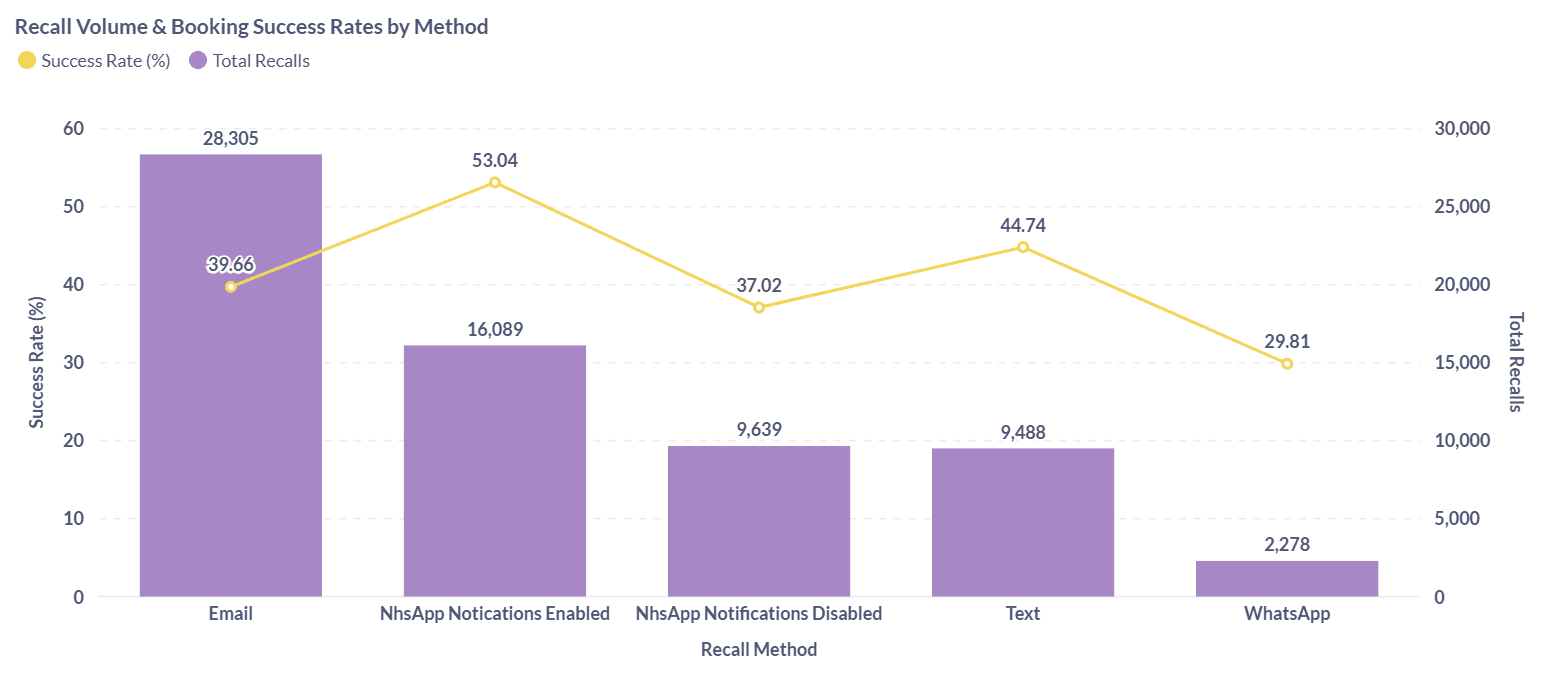
An analysis of over 50,000 patient recall events between February and June 2025, across 60+ practices and five communication channels, found that NHS App notifications with push alerts enabled achieved a 53% booking success rate — the highest of any channel, and more than double the industry average for manual recall processes.
The data
Channel | Success rate | Volume |
|---|---|---|
NHS App — notifications on | 53% | 16,089 |
SMS | 45% | 9,488 |
40% | 28,305 | |
NHS App — notifications off | 37% | 9,639 |
30% | 2,278 |
The gap between NHS App with notifications on (53%) and off (37%) is particularly revealing: it's not simply being in the app that drives performance, it's the push alert. A timely, trusted notification from an NHS-branded source converts intent into action before distraction sets in.
Email had by far the highest volume — 28,305 sends — but the lowest efficiency of the digital channels. SMS performed strongly at 45%, but still trails the NHS App by 8 percentage points. WhatsApp was the weakest performer, likely reflecting channel saturation and lower perceived trust for clinical communications.
Why the NHS App outperforms
Three factors explain the NHS App's performance advantage. First, patients already use it for prescriptions, test results, and appointment management — a recall arriving there feels clinical and relevant, not like marketing. Second, the deep-link booking journey eliminates friction: patients go directly from notification to appointment slot in a single tap, with no login required and no external website to navigate. Third, the NHS brand itself carries trust that no third-party channel can replicate.
The comparison between notifications-on and notifications-off is the clearest evidence: the app itself is a strong channel, but the push alert is what makes it the best channel.
Operational and financial impact
The performance uplift has real downstream consequences for practices. With more patients self-booking on first contact, the need for follow-up chasing drops significantly. Practices using NHS App-led recall report saving an average of 16 hours of admin time per week — the equivalent of two full working days redirected away from manual outreach.
For a typical 9,000-patient practice, that translates to approximately £24,960 saved annually in blended admin costs — before accounting for any uplift in QOF income from improved recall completion rates.
"Hippo saves over half the time — over 3 months of work for over two care coordinators for one campaign."
The right channel for each patient
The network-level data points to NHS App as the optimal default. But Hippo's approach goes further: the platform learns from individual patient behaviour over time, prioritising not just the best-performing channel overall, but the most effective channel for each specific patient. For a patient who consistently opens NHS App notifications, that's the lead channel. For one who responds faster to SMS, the system adapts accordingly.
The goal is simple: every recall should feel timely, relevant, and easy to act on — regardless of how that patient prefers to be reached.
Scale
Hippo's NHS App integration is live across 60+ practices, supporting over 1 million patients. With no on-site installation required and a sub-2-hour go-live process, the platform is designed for rapid rollout across ICBs and PCNs.
Hippo is currently the only recall automation tool that contacts patients natively via the NHS App.
"Hippo is worth its weight in gold."