Closing the Recall Gap: How Translated Recalls Reach the Patients English Messages Miss
Practice Name
Network-wide · 60+ practices
Location
UK
List Size
500,000+
+14% uplift
when Pashto-speaking patients are recalled in their preferred language vs English — Bengali shows the same uplift
In primary care, recall effectiveness is often discussed as a capacity problem. But for practices serving linguistically diverse communities, it is just as often a communication problem. A patient who receives a recall message in a language they cannot easily read is not disengaged — they are unreached.
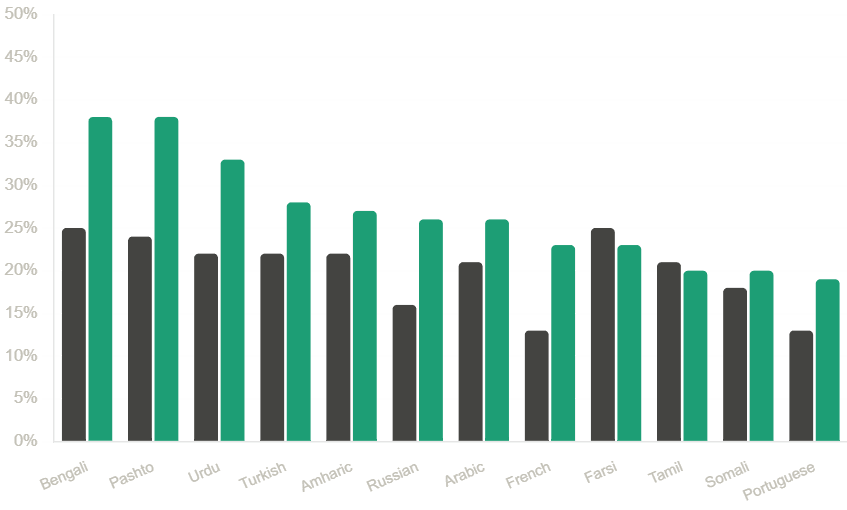
An analysis of over 70,000 recall events to non-English-speaking patients across the Hippo network reveals a consistent and meaningful pattern: patients recalled in their preferred language respond at significantly higher rates than those recalled in English. For Bengali, Pashto, and Urdu speakers — communities with well-documented health inequality in cardiovascular and metabolic conditions — the uplift is between 11 and 14 percentage points.
The data
Across the Hippo network, over 66,677 recalls were sent in English to patients whose recorded language preference is not English. These patients responded at a rate of 16% — compared to 19% for those recalled in their preferred language.
That aggregate 3pp gap understates the impact for individual language communities:
Language | Recalled in English | Recalled in preferred language | Uplift |
|---|---|---|---|
Bengali | 25% | 38% | +13pp |
Pashto | 24% | 38% | +14pp |
Urdu | 22% | 33% | +11pp |
Turkish | 22% | 28% | +6pp |
Amharic | 22% | 27% | +5pp |
Russian | 16% | 26% | +10pp |
Arabic | 21% | 26% | +5pp |
French | 13% | 23% | +10pp |
Portuguese | 13% | 19% | +6pp |
Somali | 18% | 20% | +2pp |
For Bengali and Pashto speakers, recall in the preferred language generates a response rate roughly 50–60% higher than a recall in English. For a practice with 200 Urdu-speaking patients on its hypertension register, the difference between a 22% and 33% response rate is approximately 22 additional patients completing their annual review — potentially the difference between an indicator sitting below threshold and clearing it.
Consistent across campaign types
The uplift holds across multiple clinical programmes. Comparing the same campaigns run with and without translation across the network:
Campaign | Translation on | Translation off | Uplift |
|---|---|---|---|
NHS Health Checks | 50% | 37% | +13pp |
Blood Pressure | 37% | 11% | +26pp |
Flu | 34% | 27% | +7pp |
Asthma review | 39% | 34% | +5pp |
FIT Safety Netting | 43% | 36% | +7pp |
Smoking Status | 30% | 19% | +11pp |
The NHS Health Checks comparison — 3,766 translation-enabled recalls vs 3,391 without — is the most statistically robust in the dataset, showing a consistent 13pp uplift across a large, network-wide sample.
How it works
Hippo reads the language preference field from each patient's EMIS record at the point of campaign configuration. Where a non-English preference is recorded and the language is supported, the recall message is automatically delivered in that language — no manual translation required per patient, no additional admin overhead.
Hippo currently supports over 30 languages, covering the vast majority of non-English language preferences recorded across its network.
The equity case
The conditions most dependent on annual recall — hypertension, diabetes, asthma, COPD — are also the conditions most prevalent in communities most likely to have non-English language preferences. South Asian communities carry higher rates of type 2 diabetes and cardiovascular disease. NHS England's Core20PLUS5 framework identifies ethnicity and deprivation as primary drivers of health inequality in exactly these conditions.
Practices in high-diversity areas that send recalls only in English are systematically under-serving their most at-risk patients — not through clinical intent, but through a default communication choice. Hippo's translation feature removes that barrier at the cheapest possible point in the care pathway: the recall message itself.
For practices under Core20PLUS5 reporting obligations, it is also an auditable, attributable action — a mechanism for demonstrating that the practice has actively reduced a known communication barrier for a defined patient population.
Analysis based on recall data from April 2024 to March 2026 across the Hippo network. Response rate defined as appointment booked following recall send. Language preference sourced from EMIS patient records. Languages with fewer than 30 recalls in either group excluded.